The latest aspect of hiking and camping that I have been spending way, way too much time researching is water filtration. I need to decide on which brand and what size of filter to purchase. However, while comparing different products, I got sucked into a rabbit hole while looking at one particular product.
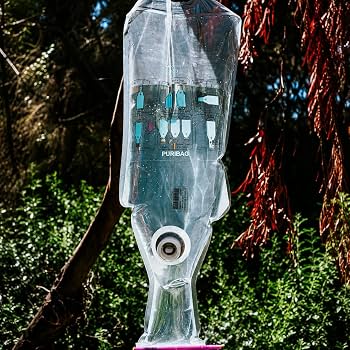
Puribag is a water purification system that purports to take the dirtiest, most rancid water you will ever hope to find, and somehow render it potable. The way it works is you full this giant 2.5 gallon (10 liter) bag with the water and then dump in a purification packet and shake vigorously for 5 minutes. Then you hang the bag from a tree or something. After 30 minutes the impurities in the water clump together and sink to the bottom of the bag. Once that happens you clip the debris to segregate it from the rest of the clear water and dump it out. Then you can open the tap and drink it or use it to cook with or whatever you want to do with it.
The rabbit hole I fell into was researching how the system works. I mean, I know how it works. I just described it. I mean how the how part works. What exactly is the purification packet? How does the packet make the dirty part of the water clump together like that? How does it know? Magic, or science, or a little bit of both? To answer those questions we have to dig a little deeper into how drinking water is processed and the power of inorganic chemistry.
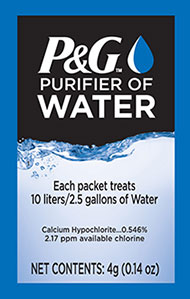
The first thing you notice when you look at the front of the packet is that it contains calcium hypochlorite. But that wouldn’t have any role in causing the clumping of material we see in the video above. The second thing you notice on the front of the packet is the amount of calcium hypochlorite, 0.546%. In other words, 99.454% of this stuff is something other than calcium hypochlorite. What is that something else? We need to look elsewhere for the answer.
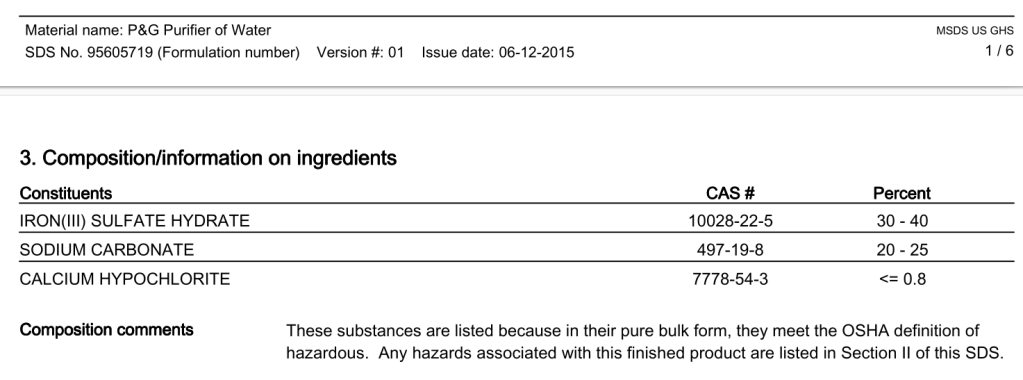
Fortunately, I found a safety data sheet (SDS) for the P&G purifier of water online. It shows that 30-40% of what’s in the packet is iron(III) sulfate hydrate, also called ferric sulfate. The ferric sulfate is the secret sauce that does most of the heavy lifting. The 20-25% sodium carbonate in the packet keeps the overall pH within an optimal band to allow the magic to happen.
When ferric sulfate is added to water the first thing it does is dissociate into positive ferric ions and negative sulfate ions. Since water is highly polar, particles suspended in it tend to be negatively charged. This negative charge electrostatically repels the particles from each other and is one big reason everything dissolves in water so well. The ferric ions adsorb to these molecules and neutralize their charge, allowing them to coagulate.
At this point we need to go back to that snapshot from the SDS. Notice how the combined weights of the iron sulphate, sodium carbonate, and calcium hypochlorite only equals from 50-65% of the total mix. That’s because the SDS will only include potentially hazardous materials. A quick read of the patent application for the P&G purifer of water tells us that it also contains materials like chitin, clay, and cellulose. These ingredients will aid in flocculation.
Flocculation is the fancy term for the aggregation and sedimentation of particles from a colloid. To dumb that down another couple of grade levels, it is when a bunch of tiny stuff in a suspension clumps together and slowly falls out of solution. The flocculants from the previous paragraph are mostly water-insoluble and comprised of polymers that give them a large size. As such, they can sweep through the water like big sails and present attachment points for the coagulated particles.
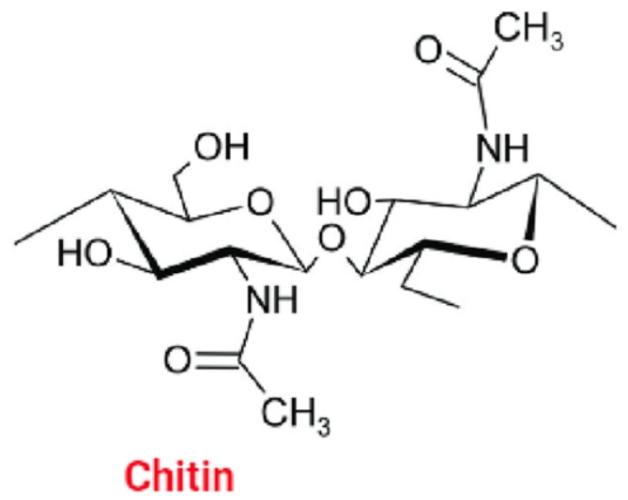
As coagulated particles combine with flocculants, they form “flocs”. Flocs get bigger and bigger as they join hands with more and more particles and other flocs. Eventually the flocs become so big that their density causes them to sink to the bottom of the bag.
After this step most of the foreign organic and inorganic matter has been removed from your water. This includes heavy metals like arsenic, as well as parasitic cysts such as Cryptosporidium parvum. Once all this stuff has precipitated out, the calcium hypochlorite gets its turn to shine.
The only ingredient actually listed on the front of the packet is used as a disinfecting agent. It is coated with a hydrophobic material like wax, so that it does not release as soon as it gets added to the water. It bides its time for the first five or ten minutes and then enters the fray to take care of bacteria and viruses only after everything else has been successfully bound. The majority of the 30 minute wait time is to allow this critically important step to complete.
Once the debris gets dumped from the Puribag the water is ready to be enjoyed. The final step is passing it through a filter on the spigot. That filter is a 0.1 micron hollow filter using activated carbon from coconut shells. Yes, you read that correctly, coconut shells. The preparation of shells to transform them into usable filters is also a multi-step process.
First, the inner portion of the shell is separated out and then it is cleaned, dried, and crushed into small pieces. The pieces are then heated at hundreds of degrees in a low oxygen environment in a process called pyrolysis. After pyrolysis the coconut shells transform into charcoal. Then the charcoal is activated with steam to open additional pores in the carbon. Once activated, the extra pores create untold surface area on the charcoal. One teaspoon of which can contain as much area as a football field. This large surface area adsorbs any molecules that might still be left in your treated water. Chiefly, it will capture molecules that might have unpleasant tastes or odors. The extraordinary adsorptive properties of activated charcoal are why it is used to treat poison victims. The charcoal can compete to suck up the poison before all your squishy and important vital organs do.
This water purifying technology is not really very applicable to hiking. Rarely would you ever need to purify 2.5 gallons of water at once, unless you were responsible for getting potable water for your whole tramily. It is definitely possible to purify more water than you need at once and carry it around with you. Keeping in mind that water weighs approximately 8 pounds per gallon, you are talking about up to 20 extra pounds in your load. Not something most people would willingly agree to when life straws, one liter purifiers, and boiling exist.
Camping is a fantastic use for this product. You can set up camp and get a couple gallons of water ready within an hour. But you know who really makes great use of the purifier of water packets? Third world countries.
Here is another video that includes an interview with the inventor of the purifier packets. He talks about the three-step process of coagulation, flocculation, and disinfection (starting @ 3:41). Fair warning, this video does contain a jump scare with admitted adulterer and Epstein associate Bill Gates @ 5:25.
Phil Souter was in laundry research in the 1990s when he came up with the idea that would become the P&G purifier of water. That satchet makes it possible to generate 2.5 gallons of clean water from inputs of dirty water, a bucket, a spoon, and a cloth to use as a makeshift filter. Dr. Souter received an Order of the British Empire for his work. P&G helped establish Children’s Safe Drinking Water, a charitable arm that gives away purifier packets to communities in need of them. They have worked to clean over 25 billion liters of water around the world.
I spent a fair amount of time in this rabbit hole, reading patent applications and scientific papers, just because I found the story so enthralling. The science underpinning it is intriguing as well. In the words of Marge Simpson, I just think they’re neat! Now I need to get back to analyzing the different trade-offs between LifeStraw and Grayl.

