Author: ecg8c46f776730a

  • Happy Twentieth Birthday

    Photo by Wiktoria Skrzekotowska on Unsplash

    September 4, 2006 was twenty years ago today. I celebrate that day each year because it is the day I quit smoking. Or, more accurately, it is the most recent day I quit smoking and the first time I did not start smoking again within a few months. I treat this date as though it is another birthday because quitting smoking gave me a new lease on life. And I didn’t even need to do a credit check and put down a security deposit for this one.

    I started smoking fairly late for someone who grew up in the rural south. I never smoked in high school despite my dad smoking over a pack a day for my entire life. Some of my earliest memories of my dad are of me sitting on the floor playing with toy cars while he filled the entire room with smoke that I imagined was the cool fog my mini racers were navigating on their obstacle course that included our coffee table and the legs of his chair. I never took up smoking until late in college, but I quickly made up for lost time. Smoking is one of those things you understand is disgusting and bad for you the entire time you participate, but because it is an addictive drug you are powerless to do anything about it.

    Marlboro Reds were my cigarette of choice. I loved Reds more than baseball fans in Cincinnati. Every time I smoked a cig that wasn’t a Red, I would think of how much better a Red would be. I was able to keep my habit down at about a half pack a day for the decade or so that I smoked. I tried to quit many times. Or, to be more accurate, I actually did quit many times. I just started back up again after a few weeks or months.

    I remember when Boston outlawed smoking in bars back in 2003. I was certain that was going to be the tipping point and I could easily quit if the bars were off limits. Fast forward to me standing around in the freezing cold outside of the Druid in Inman Square taking drags and shivering my ass off.

    I kept trying to quit many other times. Being in the Army sabotaged my attempts as much as anything else. I got to the point that I could quit for the entire month, but come drill weekend I just had to get a pack to smoke in order to make it through the day. One pack to survive the weekend would become a few packs to survive the entire week of, which eventually just became me starting to smoke all over again.

    I know now that my whole problem was that I never really wanted to quit for me. I wanted to quit because cigarettes cost a lot of money. Or I wanted to quit because society told me I should quit. Those were external motivations, and they just weren’t good enough for me. I never actually wanted to try and quit purely for myself until I realized just how destructive it was for my own life.

    Ben Affleck puts it very well in an interview with Howard Stern. Here, he talks about how he was not able to quit drinking until it all but ruined his life. “The cure for addiction,” as he states, “is suffering.”

    In summer 2006 my Reserve unit went to Fort McCoy in Wisconsin for Annual Training. We were there for an exercise with many other Chemical units around the country. On the way there I bought two cartons of Reds, expecting them to last the entire two week trip and beyond. I was wrong.

    I’m not sure what was different about this AT that made me smoke so much more than usual. Yes, it was hard, but AT was always hard. There was a lot of “hurry up and wait”, but that was also nothing extraordinary. Whatever it was, all I did was smoke and smoke and smoke. In two weeks, I smoked both cartons. A carton is ten packs of cigarettes, each pack containing twenty cigarettes. And yes, I did lend lots of smokes to people, but I also bummed at least as many from others.

    Basically I smoked a pack and a half each day. An explosive increase from half a pack a day. Once I got home I knew there had to be a major change. I did not want this to be my new normal. I did not want to get cancer before 40. I did not want to have trouble climbing two flights of stairs.

    The first thing I did was set a date. I chose Labor Day because it was the end of a long weekend. I spent the weekend smoking more than normal, hoping it would cause me not to miss smoking for the first couple of days. On Labor Day itself I went to Olde Country Buffet and got a gluttinous meal of meat loaf, more meat loaf, fried chicken, red velvet cake; all the normal stuff you get at Olde Country Buffet. A few alcoholic beverages were consumed as well. I did my best to make the entire weekend feel like a bacchanalia of vices.

    For the most part it worked. I spent most of the following week just recovering from all the overindulging. Probably the hardest part was not getting three or four ten-minute smoke breaks at work. I never missed cigarettes until the next weekend. By then I could tell myself “you’ve already made it four days, keep going”.

    Because I had so much resolve this time, it continued to go smoothly. My first drill after quitting was tough, just because when I told people I quit they didn’t believe me. So they spent the whole weekend trying to shove lit cigs into my mouth. Other than that, I would occasionally see someone smoking and get an overwhelming feeling of envy. It felt like an itch on my heart. I just desperately wanted to steal that person’s cigarette and smoke it for myself. This happened every few days initially, then slowly got progressively further spaced out. Even now I still get that feeling once every 9 months or so.

    The biggest downside was weight gain. There is a reason every thin, beautiful, eastern European supermodel smokes like a chimney. I slowly put on pound after pound despite doing and eating exactly what I did before. That frustrated the shit out of me, because I was supposedly getting healthier as I watched my pants get tighter and tighter. I put on about 12 pounds before I finally got a handle on it around Thanksgiving, then I needed a few months to lose it all back.

    The second biggest downside was that I picked up spitting outdoors. Like, all the time outdoors. I had developed an oral fixation with the cue that being outside meant my mouth needed to be busy. When I stopped smoking I started spitting all the time, but only outside. It’s pretty fucking disgusting but I have no idea how to stop doing it without smoking again.

    The positives are great. I save tons of money that I used to spend on cigarettes. My health and endurance are as good as I could hope. It has truly been a complete life transformation, and that is why I treat it as a second birthday.

    Of course, having a birthday on 9/4/06 means I share a birthday with the Queen Bey herself. For my 20th birthday and her 45th, we need to have a dance party celebration!
  • Southern Walnut Creek Trail

    In chapter 11 of the Book of Judges we are introduced to Jephthah. He is the bastard son of Gilead and gets forced into exile because his legitimate brothers will not share their inheritance with him. While in exile, he is exhorted to lead Israel’s armies against the Ammonites.

    Before the fateful battle, Jephthah prays to God for assistance. In return he vows to make a burnt offering of the first person to emerge from his house. God delivers a victory for Israel and when Jephthah returns home his only daughter is the first person that comes out to meet him. Awkward. Being a man of his word, he made an offering out of her.

    In the twelfth chapter, the Ephramites threaten to burn Jephthah’s house down. Not because he killed his daughter, but because he fought the Ammonites without asking their help first. Jephthah goes to war with the Ephramites and routs them. As the Ephramites attempt to flee over the river, the Gileadites make everyone who tries to cross pronounce the word “shibboleth”. Because of linguistic differences, Ephramites pronounced the word as “sibboleth” making it easy to know which ones to allow to cross the river and which ones to kill. 42000 Ephramites died, so the method was coldly efficient.

    Anyway, that story is where we get the word “shibboleth” which is any word or phrase that can be used to distinguish between in-groups and out-groups. One common shibboleth is in the way place names are pronounced. People local to an area will know the pronunciations, but tourists or recent arrivals will get tripped up and mark themselves as part of the out-group.

    Living in Las Vegas, the most common shibboleth was the pronunciation of the state name. Locals would say it correctly as “ne-VADD-uh”. People whose sole purpose in life was to crawl into casinos and empty their wallets so we could avoid paying state income taxes would pronounce it “ne-VODD-uh” or some other appalling way.

    Massachusetts was full of geographical shibboleths. This happens when the place names are a melange of American English, British English, and Native American words. Then each word gets filtered through a heavy Bawstin accent. This is how you wind up with Worcester pronounced “WOO-stah” or Cochituate as “co-KIT-chew-it”.

    Like those states, Texas also has shibboleths. I dare anyone to say Pedernales correctly the first time you see it. One big one in Austin guaranteed to trip you up within your first month of moving here is Manor. Pronounced “MAY-ner”. Manor is a suburb east of Austin where a host of commuters live.

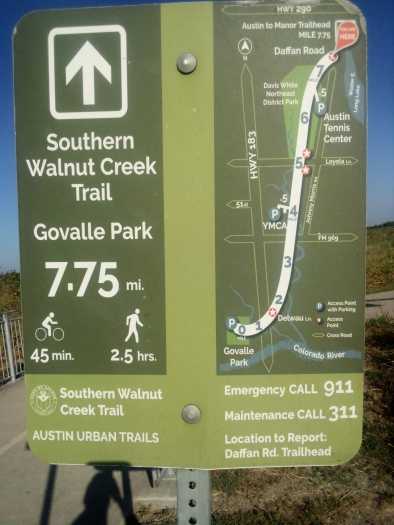
    Okay, I’m going somewhere with this meandering introduction. Manor is important to this post because there is an Austin To Manor bike trail that runs five miles and terminates at Johnny Morris Road in east Austin. Just on the other side of the street from the end of that trail is the northern end of the Southern Walnut Creek Trail. I did the Northern Walnut Creek Trail earlier this spring, so it was only a matter of time before I grabbed the 25 pound backpack and attacked this one too.

    First things first, this trail was very wide and well kept. It definitely functions chiefly as a bike trail with hiking being a second priority. The entire thing was paved with almost no potholes or visible cracks or anything. Every section had lots of signs about upcoming curves and reminders to slow down in hilly sections. I enjoyed it as a hiker, but I feel like if I was a biker this would be my favorite trail by a wide margin. Oh, and there were lots of trees and shade. This was great because Austin is currently in the grips of a seemingly never ending run of consecutive 100 degree days in August.

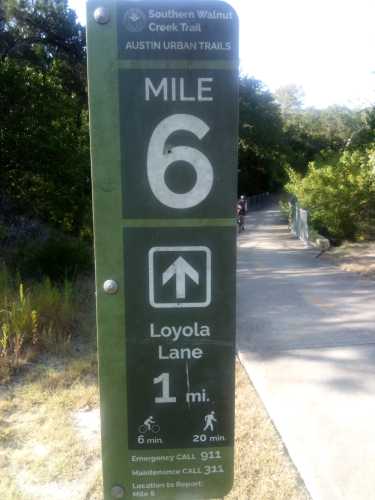
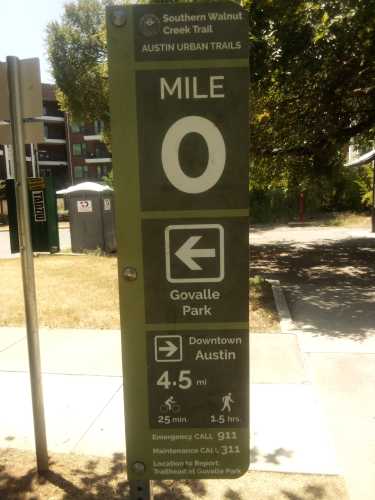
    Second thing second, you’ll notice that the sign is showing the miles to the end of the trail instead of beginning at mile zero. Mile zero is on the southern end closer to downtown. I started on my less preferred end for two significant reasons.

    One, the northern end is difficult as fuck to get to using public transit. I had to take two buses and then hoof it almost two miles to reach the start point. Conversely, the opposite end was only about a quarter mile from a bus stop. I figured it would be better to inconvenience myself at the beginning of the day before it got too hot than to walk the entire trail and then have an hour of walking to look forward to.

    Two, doing it this way allowed me to go somewhere exciting close to the mile zero marker. Sort of like the pot of gold at the end of the rainbow. I’ll leave exactly what that place was until the end of this post.

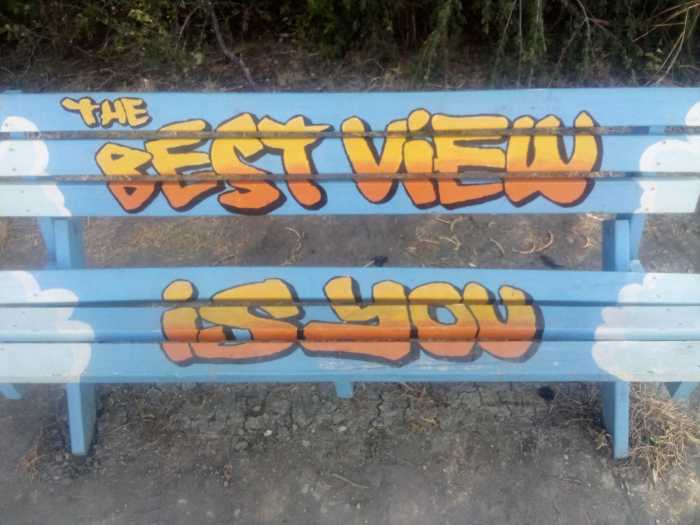
    One of the more interesting sights along the first couple of miles was this painted bench.

    I’d like to say, for the record, that whoever painted this bench never saw my face. If they had they would never say it was better than any view. In all fairness though, I guess I need to share the view from this bench before I can say it is definitely better than my visage.

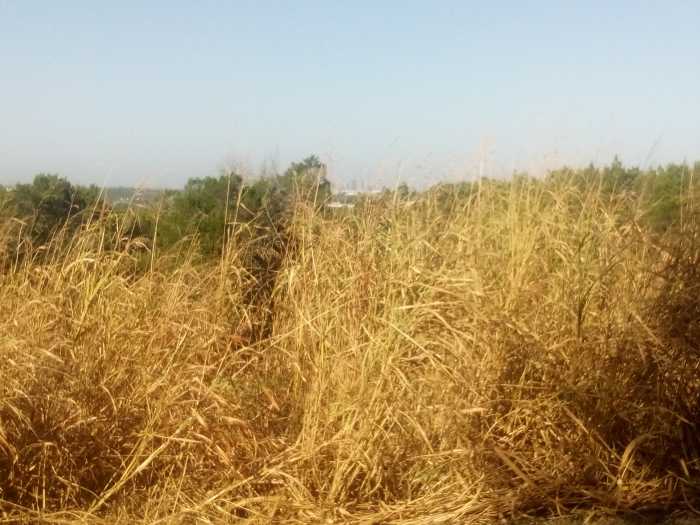
    You can make out a faint view of downtown beyond the green trees. If you can get past the mountain of tall, brown, dead and dying grass. In addition to being 100 degrees every day in August, water has been in short supply. The airport has seen a grand total of 0.02 inches of rain this month. Most every living thing in town is either slowly dying outside or complaining inside in their underwear sitting next to the air conditioner.

    The trail meanders along for a few miles and then runs along beside Harvey Penick Golf Campus. In addition to a nine hole golf course, they also host a footgolf course. Footgolf is pretty much what you think it is. You kick a soccer ball around a golf course until you kick it into an oversized hole. Fewest kicks wins.

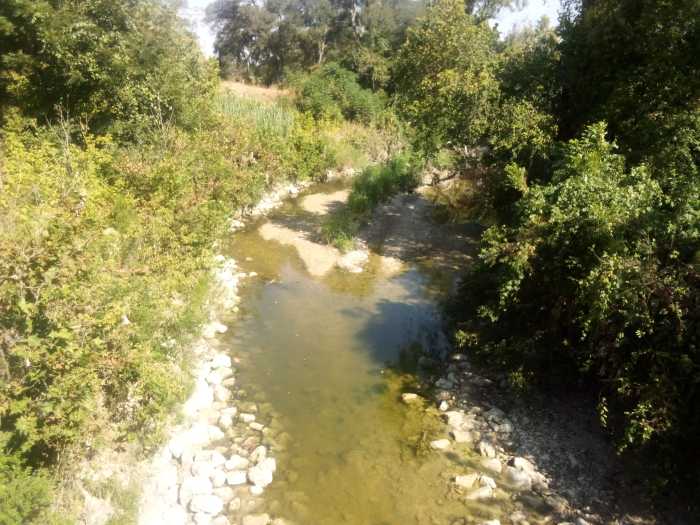
    At least you could see some green grass on the golf course. Check out this bridge over Walnut Creek that showed how low the water level was.

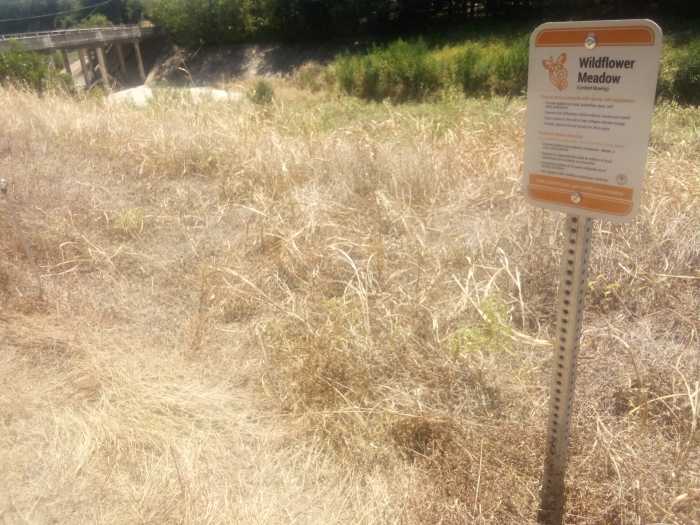
    Not to belabor the dryness in Texas right now, but I’m going to do just that. The Ross fire continues to rage west of the Metroplex. Honestly, as bad as conditions are it could have happened anywhere in the Lone Star State. I passed a “wildflower meadow” in name only.

    If nature’s first green is gold, then her last green is brown. With apologies to Robert Frost, I’d like to wax poetic about summertime in Austin.

    Nature’s last green is brown, once you notice it gets you down.

    As temperatures climb ever higher, everything might catch fire.

    This recap might make it seem like I was depressed the entire trip, but that would be far from the case. Truth is, Austin always gets hot and dry in the summer. It’s not as bad as Lake Powell or anything, so we’ll be just fine. Fingers crossed.

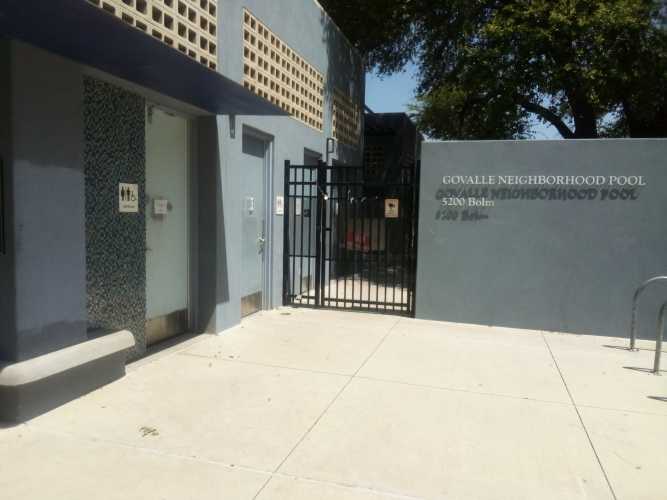
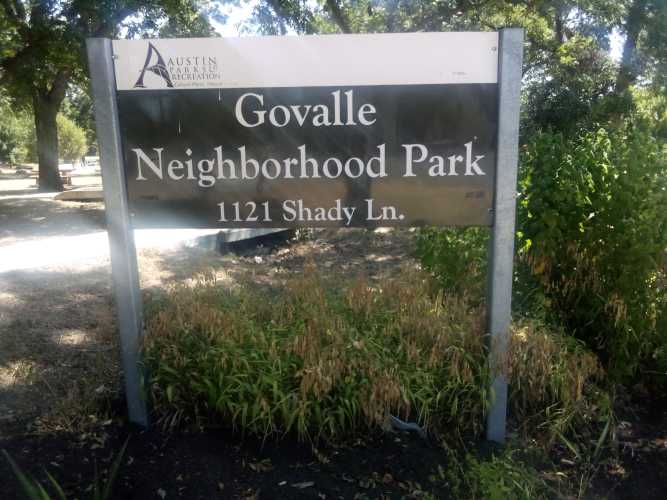
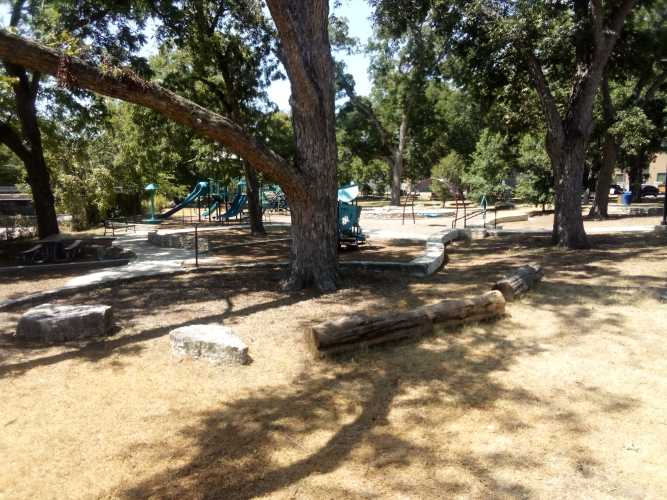
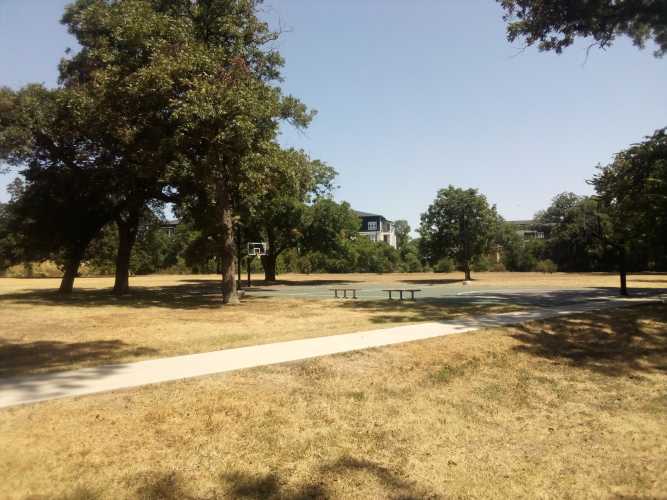
    Nothing much eventful happened until I reached the southern end of the trail at Govalle (pronounced “go-VAL-ee”) Neighborhood Park. Remember when I said earlier that this trail catered to bike riders? Once I got to Govalle Park I realized that there were no bathrooms or water fountains anywhere along the main trail. Fortunately the park had nice restrooms and water fountains with faucets for filling water bottles.

    I took a few other pictures at Govalle Park, so I might as well show them off here.

    After milling around in the park for a while, it was time to go check out that sweet mile zero marker and bring this hike to an end.

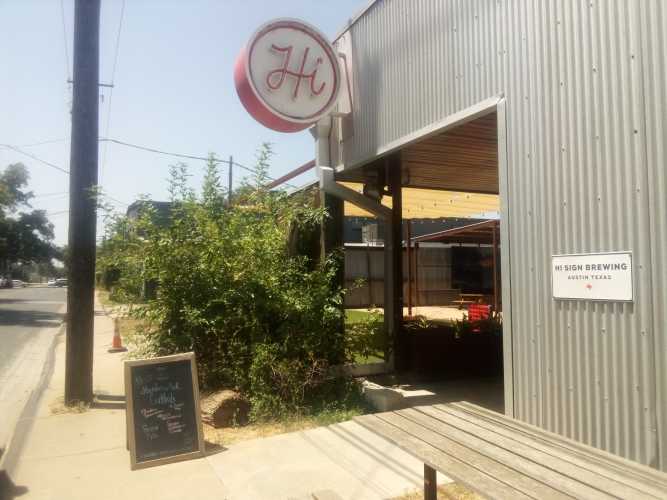
    But, of course, this was not really the conclusion because I promised a pot of gold at the end of this rainbow. I walked about half a mile down Shady Lane from the park and found my destination, Hi Sign Brewing.

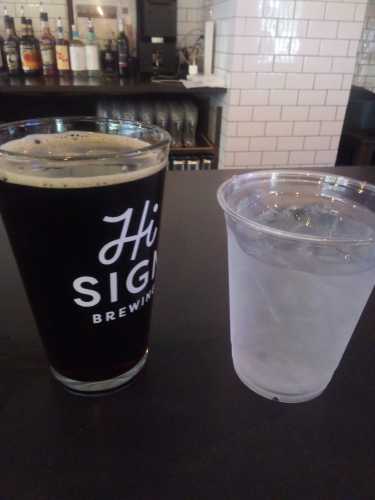
    I had to try their Millie Brown Ale, an American brown, and got a cool cup of delicious ice water to stay hydrated.

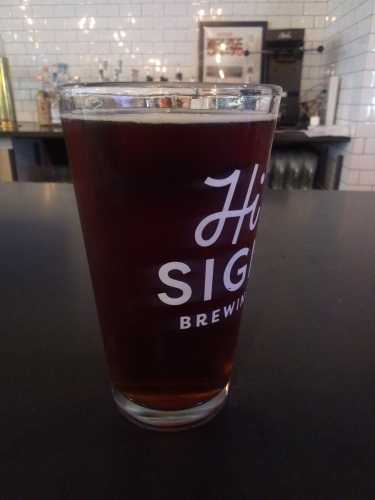
    After that, it was time for a Shamus Irish Red.

    Both beers were refreshing but, truth be told, the service was less than desirable. Despite being one of only two people at the bar I had to stare daggers into the bartender before she would stop doomscrolling and come over and assist me. I get it, I’m hideously ugly. But does that mean I’m not entitled to good service? I am not an animal!

    After the second beer it really was time for my journey to end. I don’t really have a closing statement here, so that’s it. Drive home safe.

  • 12 Things You Didn’t Know About Ibuprofen


    There have been a rare few discoveries since the dawn of time that were seminal in the course of history. You can draw a thick black line and divide all events into “before this” and “since this”. I’m talking, like, the invention of agriculture. The introduction of cavalry in warfighting. The creation of the printing press. And, if you are over the age of 40, you have to include the discovery of ibuprofen.

    Being over 40 means spending each day simply trying to manage the aches and pains and humiliations of just trying to get by in life. Putting on socks is legitimately the most difficult thing I do eight out of ten days. Everything is so hard and hurts so much. I don’t know how anyone in olden times did it without taking two ibuprofen in the morning, and sometimes two more in the afternoon. Hikers also don’t need to be told about the virtues of ibuprofen. Its nom de guerre on various trails is Vitamin I.

    In salute to this miracle drug, I thought it would be cool to regale you with twelve facts about ibuprofen you never knew. Unless you are a chemist or pharmacologist, in which case you definitely know these.

    1- Ibuprofen is a word formed from pieces of its original chemical name: iso-butyl-propanoic-phenolic acid.

    2- Stewart Adams, one of the scientists who discovered the drug, once used it on himself to cure a serious hangover while it was in clinical trails.

    3- Because of those hangover elixir properties and ibuprofen’s ability to ease menstrual pain, Stewart Adams once made a list of “50 men who really understand women”

    4- Ibuprofen is a racemic mixture. Only the S-enantiomer is active and the R-enantiomer is converted by the body into the S once taken.

    5- Ibuprofen piconol is a major ingredient in one of Japan’s best-selling anti-acne creams.

    6- Samantha Reckis and her family sued Johnson & Johnson after a reaction to Motrin caused toxic epidermal necrolysis and partial blindness in 2003. They were awarded over $100 million.

    7- Ibuprofen should never be given to children under the age of six months. This is because the primary organ that metabolizes it is the kidneys, which are not fully developed before six months.

    8- John Nicholson, a chemist who also helped discover ibuprofen, got a bachelor’s and doctorate from Oxford University.

    9- Storing ibuprofen in your bathroom (as opposed to someplace cool and dry) can cause it to fall below 75% potency after one year.

    10- Ibuprofen is marketed under many different names across the world. Here are some: Back Pain (Colombia), Bravex (Georgia), Brufen Retard (Turkiye), Fenris (Indonesia), Flamex (Bangladesh), Mypaid (South Africa), Toni (Taiwan)

    11- In 2014 a man reported having increased libido and erectile function for six hours after taking ibuprofen following a root canal. He did, in fact, call a doctor.

    12- Ibuprofen functions by blocking the creation of prostaglandins. The 1982 Nobel Prize in Physiology was awarded for work that led to the discovery of prostaglandins and similar substances.

  • 183 Trail

    To start 183 Trail you just start walking south from somewhere near the intersection of US 183 and US 290 along the 183 service road.

    Service roads are a concept I had never heard of before moving to Austin, but I think they’re neat. Any major thoroughfare in Texas has a surface street running parallel to it where businesses live and which you can use to go wherever the highway goes without having to actually get on the highway and deal with highway driving. Obviously, you want to use the highway to go more than 5 miles, but for short trips I always choose to stay on the service road.

    This time I threw on the 25 lb. pack and headed out to 183 Trail. This trail was appealing because it measures 10 miles running north-south alongside 183 and 183 Toll Road between northern Austin and the airport. While the other trails I’ve done so far (walnut creek, shoal creek, etc) have all been maintained by Austin Parks Foundation, 183 Trail falls under the purview of the Central Texas Regional Mobility Authority (CMRTA). This means there are some good and (mostly) bad differences between this trail and all of the other ones I’ve talked about previously.

    A quick aside here. For reasons I do not entirely understand, 183 service road has four different names throughout Austin proper. It is referred to as Research Boulevard, Anderson Lane, Ed Bluestein Boulevard, and Old Bastrop Highway depending on exactly where you are standing when you are speaking. So as not to confuse anyone reading this, I’ll refer to it only as 183 service road. But just know that here in Austin no one ever does this.

    There was no “mile zero” signpost at the beginning of the trail, but there was this informational billboard on the roadside about a mile south of 290. The trail itself referred to these as kiosks, and this was the first one.

    click to enlarge

    I cannot emphasize this enough. If I had not seen this kiosk, I would have had no idea I was on an actual trail. This was just sidewalk on a busy service road. Cars were whizzing by and the noises of a morning commute filled the air. Most of the time there was no protected bike lane, just a little portion of the service road shoulder carved out.

    It continued pretty much exactly like this until I got to Loyola Lane and saw a sign for Davis-White Park. Since the trail was proving to be underwhelming, I figured I would undertake a side quest.

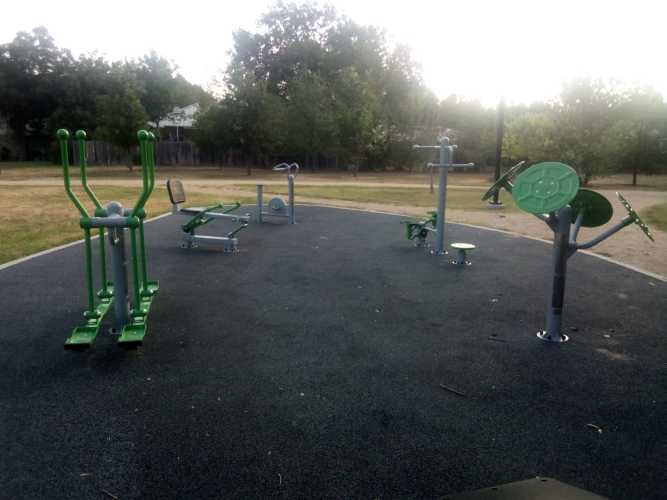
    Davis-White Park was named for Willie Ray Davis and Louie White, the first black captains of the AFD and APD. It is almost 20 acres and contains a 1/2 mile walking loop, large open spaces, playgrounds, and there was a food truck there at like 7:45am. Looking back, I probably should have taken some pictures of all that, because it was a pretty cool place. Oh well. I did get some pictures of the outdoor fitness station there. Because of course I did.

    Second from the left in the second picture is a body weight rowing machine. I unabashedly love this thing and might ask it to prom. A really good, solid piece of equipment that gave me a great strength and cardio workout in only 2 or 3 minutes of use. I’ve only seen one other example of this in my life, so it was a real privilege to find one here.

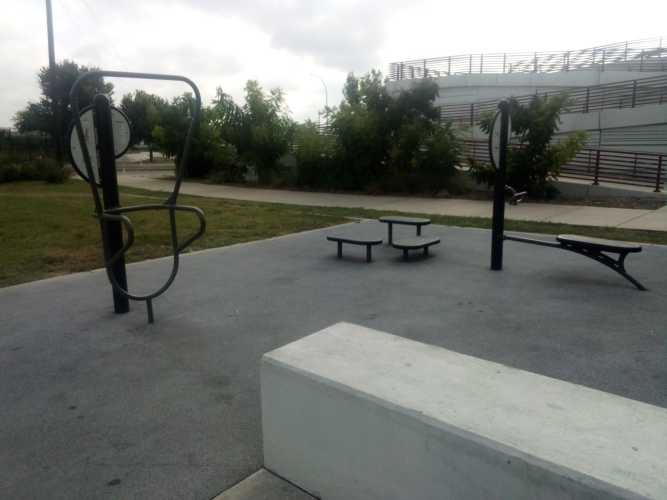
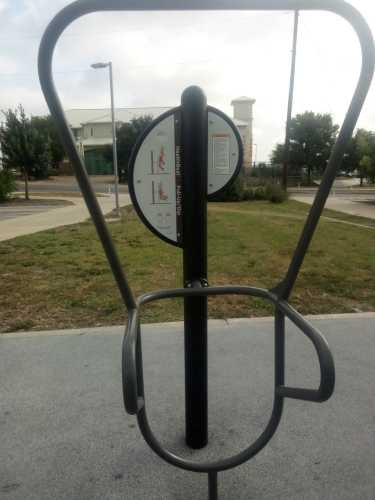
    Getting back on the trail, the next big landmark was the trailhead at 51st Street. To call it a trailhead was being charitable. It mainly consisted of parking spots, which was nothing to sneeze at but also nothing overly impressive. There was a small fitness area though, so it’s got that going for it, which is nice.

    the dip / pull-up station on the left looks like modern art
    2026. Plastic and metal on concrete.

    Directly across the street from the trailhead was the YMCA on 51st Street. Frustratingly, there was a kiosk in front of the YMCA. This meant that in order to see all of the kiosks you needed to bounce back and forth across the street multiple times. And, just to drive this point home, remember that this trail goes along next to a one-way service road that is next to a pretty big roadway with the service road in the opposite direction next to that. You needed to cross all of that to get from one side to the other.

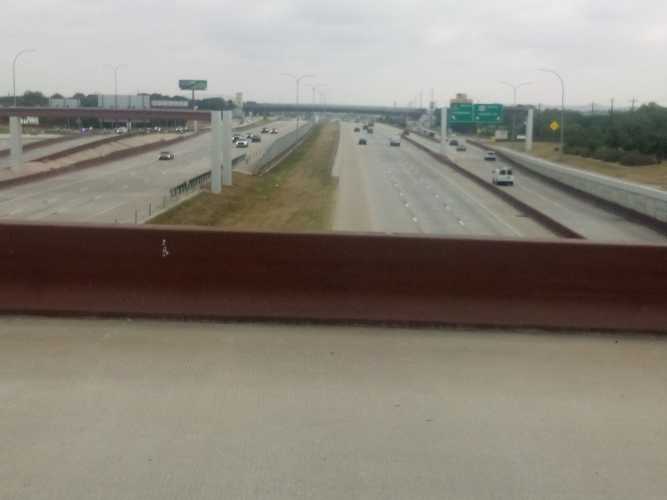
    view from a pedestrian bridge over 183

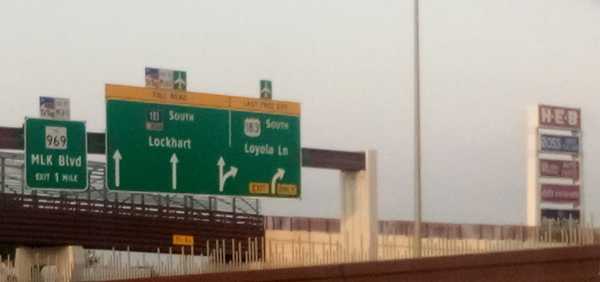
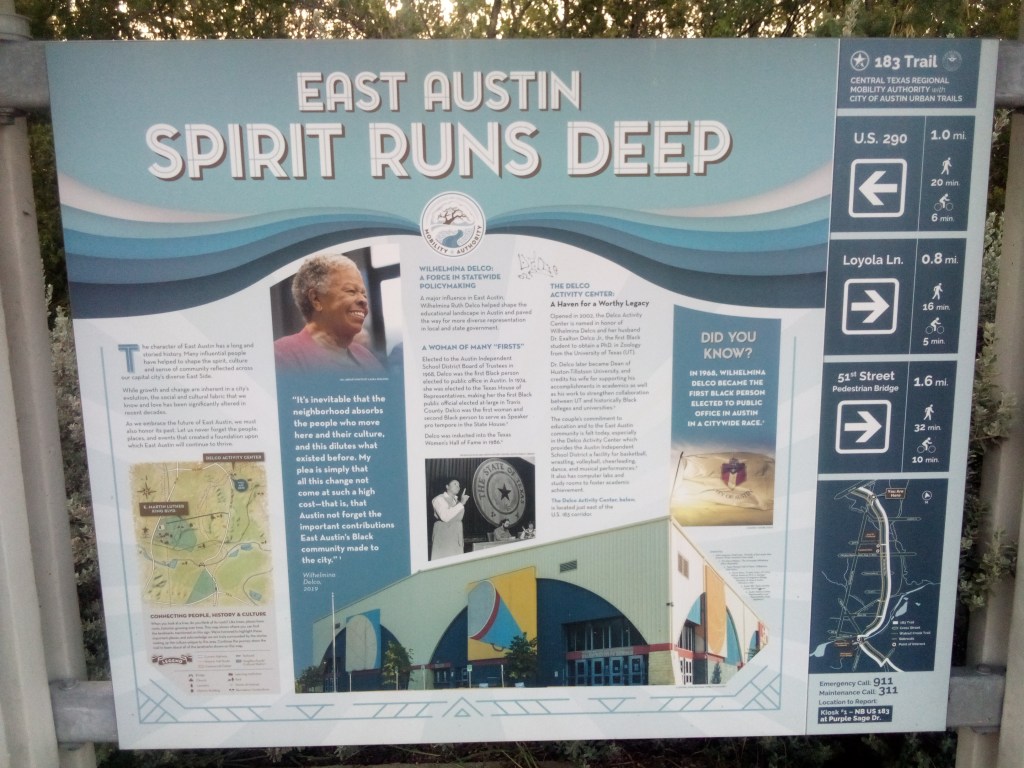
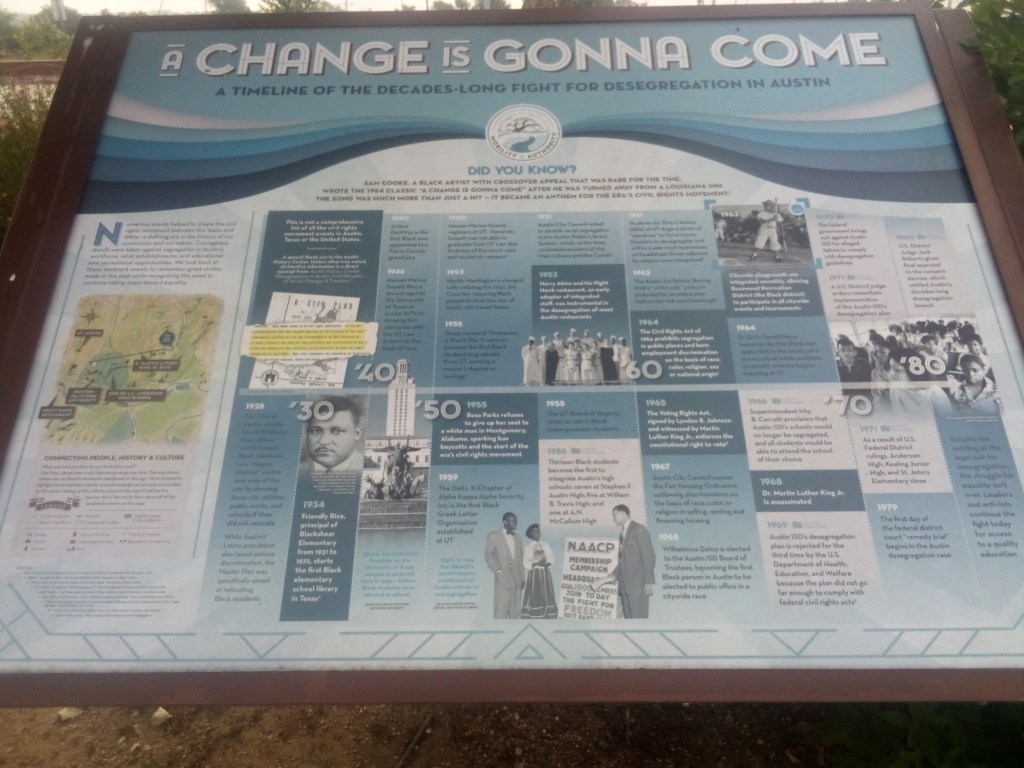
    About a half mile from that kiosk, on the opposite side of the street once again, was a cool four-panel exhibit about civil rights in Austin. The four panels were arranged in a semicircle on the northwest corner of the MLK / 183 intersection. Here is one of those panels.

    click to enlarge

    At this point you may have noticed that I showed you two kiosks and they both deal with minority pride and history. It probably won’t surprise you to learn that East Austin is home to a large population of minorities. However, it may surprise you to find out why that’s the way it is.

    Let’s take another small side quest to learn all about the Austin Master Plan of 1928. Before Austin was the weird place where everyone lived in skyscrapers and did stand up paddleboarding, it was just a small but growing Texas city. Blacks in Austin lived in several enclaves all across the city called freedsmen towns. White Austin did not like the idea of so many black residents spread across the area. The 1928 city plan was an excuse to make sure freedsmen towns all over Austin got no support from the city, in an effect to drive all black Austinites into east Austin, where the largest concentration already was. To quote directly from the plan itself:

    There has been considerable talk in Austin, as well as other cities, in regard to the race segregation problem. This problem cannot be solved legally under any zoning law known to us at present. Practically all attempts of such have been proven unconstitutional.


    In our studies in Austin we have found that the Negroes are present in small numbers, in practically all sections of the city, excepting the area just east of East Avenue and south of the City Cemetery. This area seems to be all Negro population. It is our recommendation that the nearest approach to the solution of the race segregation problem will be the recommendation of this district as a Negro district.

    Cough, redlining, cough. The systematic coerced migration of black Austin to the eastern edge of the city was only exacerbated when Interstate 35 replaced East Avenue and bisected the city like a scar. This just made it easier for white Austin to improve and grow while denying those same resources to minority Austin. Just remember that whenever “they” say the things that happen now don’t have powerful, lasting ramifications – they do in fact have powerful, lasting ramifications that outlive most people’s memories of the things that occurred in the first place.

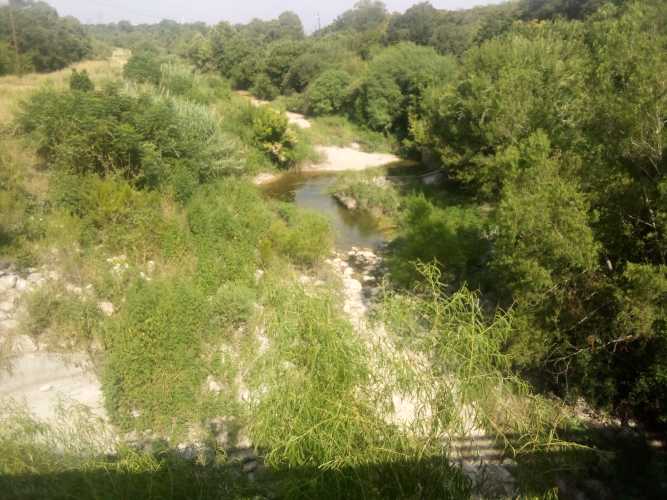
    South of MLK after a few miles I came to Boggy Creek. There was a stairway down from 183 to get closer to the creek and see some greenery. Here is a picture showing the creek water level.

    It was here at Boggy Creek where I saw a group of maybe five or six birds circling overhead. They were about half a mile away and pretty far up in the sky, so I was not able to identify them or get any photos. But it did make me realize that until that point I had not seen any other birds along the trail. Being so close to such a busy roadway, the birds simply were not anywhere to be found.

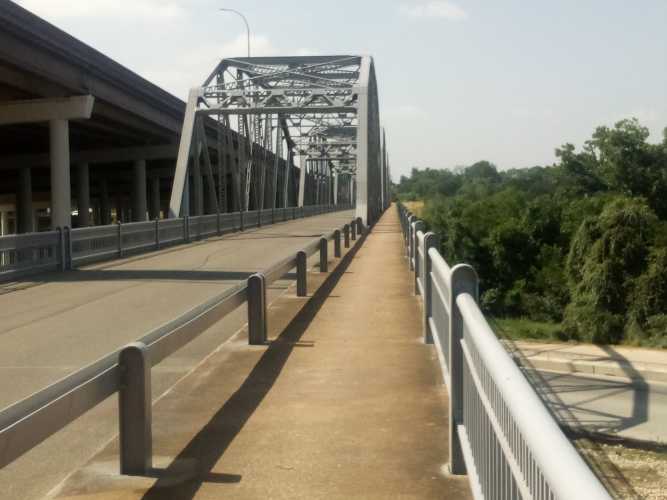
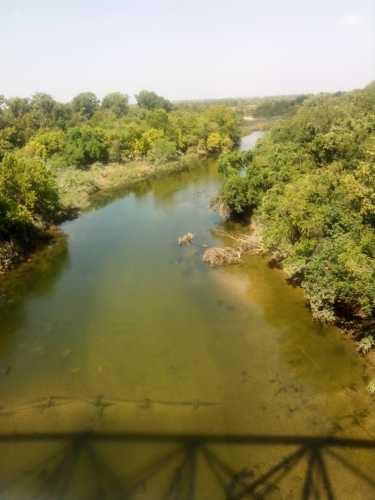
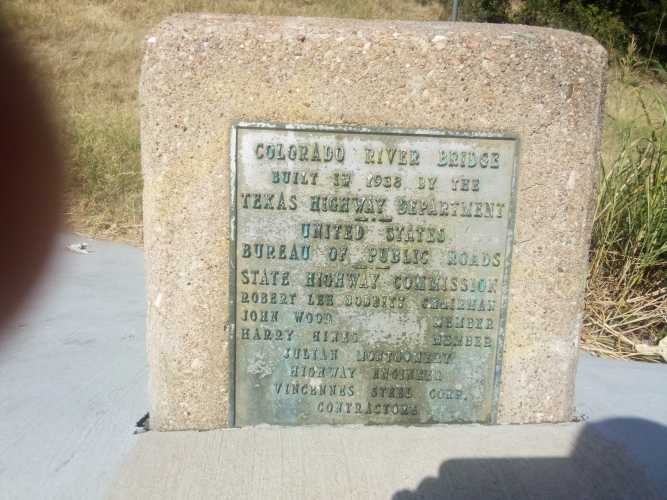
    Next up was the biggest landmark on 183 Trail, the Montopolis Truss Bridge. Listed in the National Register of Historic Places, the bridge was built in 1937-38 to replace the original bridge after it was destroyed by floods. Here is a gallery of the bridge itself, the Colorado River it crosses, and a plaque from the opening. And my blurry index finger.

    183 Trail continued south past the bridge all the way down to Austin-Bergstrom. As you can guess, there was a fair amount of traffic on that portion on 183. And that pretty much wrapped up the adventure for the day.

    I have a few thoughts about this trail in general. It really felt like they built US 183, and then someone decided or heard about some kind of program that gave out federal grants for trails. So they tried to reach out and grab that money by sticking some signs on the side of the road and claiming this was a trail. 183 trail is not a trail, it’s just a sidewalk on the side of a road. And, you know, I have no problem with it being the latter. My only problem is when you claim to be the former.

    It was a difficult trail because at every road crossing the trail sloped up to the elevated intersection, which was great because the walk was challenging. No trees meant the sun beat down constantly. I began right around sunrise, but by the last few miles the heat was nearly unbearable. I was stopping to drink water more frequently than normal. All in all; good workout, mediocre experience, but I did learn some things.